Execution Modes
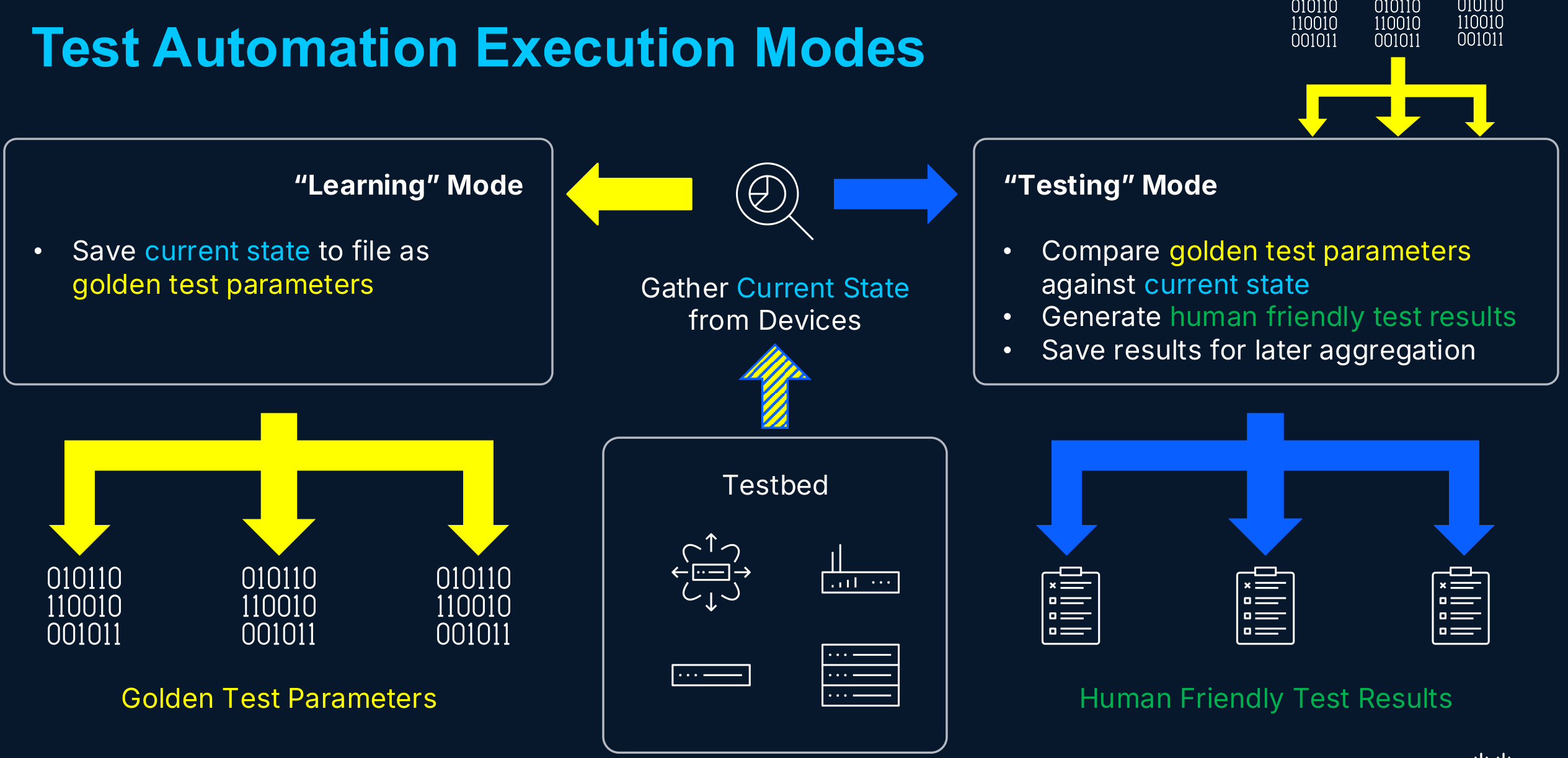
Huginn has two execution modes: learning and testing. Learning mode observes infrastructure and records what it sees. Testing mode re-observes and compares against the recording. Any deviation is drift.
Why two modes?
A test plan with thousands of test cases needs thousands of expected values. Populating those by hand is slow, error-prone, and brittle - any planned change invalidates large swaths of them. Dual-mode execution removes the manual step entirely: the framework captures expected values from the live network, then uses them for comparison on subsequent runs.
Learning mode
Learning mode captures the current state of infrastructure as the "known good" baseline.
During a learning run, each test case:
- Connects to its target devices (via the framework-managed connection broker)
- Executes commands and gathers structured state
- Saves the gathered state to a parameters file
No comparison-based pass/fail judgement occurs (though a test case will still fail if it cannot successfully gather parameters). The output is a set of parameter files representing what the infrastructure looks like right now.
Test cases whose job does not inherit LearningTestCase, such as change and action jobs, are skipped in learning mode. The phases that depend on a phase with such a test case are blocked, so a learning run never records the unchanged network as the expected state after a change. These blocked test cases do not make the run exit non-zero. See Blocking in learning mode.
When to run in learning mode
- Initial deployment - capture the baseline after confirming the network is healthy
- After a planned change - re-learn parameters that were intentionally altered
- After reconciliation - when new test case variants are created for changed infrastructure
Testing mode
Testing mode evaluates infrastructure against expectations derived from previously-learned parameters.
During a testing run, each test case:
- Connects to its target devices
- Executes commands and gathers current state
- Loads previously-saved parameters as a reference point
- Evaluates current state against the reference (the evaluation logic depends on the job's archetype - exact match, operator-based comparison, or pass/fail criteria defined by the job itself)
- Records granular results
When to run in testing mode
- Drift detection - periodic validation that infrastructure hasn't changed unexpectedly
- Change validation - run before and after a change to confirm only intended state changed
- Regression testing - verify a software upgrade or migration hasn't introduced regressions
How it works in code
Inherit from LearningTestCase and implement two methods - gather_state and compare_state:
import muninn

from huginn import Context, LearningTestCase, ResultStatus

mn = muninn.Muninn()
mn.load_builtin_parsers()


class VerifyOSPFCost(LearningTestCase):
    """Learn and verify OSPF interface costs."""

    command = "show ip ospf interface brief"

    async def gather_state(self, context: Context) -> dict[str, object]:
        """Gather current state from all target devices.

        Called in both modes. Returns structured data representing
        the current infrastructure state.
        """
        devices: dict[str, dict[str, object]] = {}
        for device in context.targets:
            result = await context.broker.execute(device, self.command)
            parsed = mn.parse(os=device.os, command=self.command, output=result.output)
            costs = {intf: data["cost"] for intf, data in parsed["interfaces"].items()}
            devices[device.name] = {"interfaces": costs}
        return {"devices": devices}

    async def compare_state(self, *, expected, current, context: Context) -> None:
        """Compare expected state against current state.

        Called only in testing mode. Records pass/fail results
        for each comparison point.
        """
        for device in context.targets:
            exp = expected["devices"][device.name]["interfaces"]
            cur = current["devices"][device.name]["interfaces"]
            for intf, exp_cost in exp.items():
                cur_cost = cur.get(intf)
                if cur_cost == exp_cost:
                    context.results.add_result(
                        ResultStatus.PASSED,
                        f"{device.name} {intf}: cost {cur_cost}",
                    )
                else:
                    context.results.add_result(
                        ResultStatus.FAILED,
                        f"{device.name} {intf}: cost is {cur_cost}, expected {exp_cost}",
                    )
The framework calls gather_state in both modes. In learning mode, it saves the return value. In testing mode, it loads the saved parameters and passes both to compare_state.
Parameter storage
Learned parameters are persisted as JSON files in the parameters directory, ./parameters/ by default. Each test case gets one parameter file, named by its test case identifier:
Use --parameters-dir or the parameters_dir key in [tool.huginn] to store them elsewhere. A learning run overwrites the file of each test case it learns. A testing run reads the current file of each test case it runs, and the test case is errored if that file is missing. Parameter files are not tied to a particular learning run.
Run results are stored separately, in a timestamped directory per run under ./results/, for example results/2026-Jun-05-09-15-00-learning/.
Relationship to scenarios
Execution mode is set for the whole run with --mode. Phases have no mode field. In a change-validation scenario, the same test case group appears in several phases:
scenarios:
  link-shutdown-r1r2:
    phases:
      pre-change:
        test_case_groups: [baseline]
      shutdown:
        depends_on: [pre-change]
        test_case_groups: [shut-link]
      post-shutdown:
        depends_on: [shutdown]
        test_case_groups: [baseline]
      normalize:
        depends_on: [post-shutdown]
        test_case_groups: [normalize-link]
      post-normalize:
        depends_on: [normalize]
        test_case_groups: [baseline]
Using this scenario takes a learning run followed by a testing run:
- Learning run (
huginn run -m learning) -pre-changecaptures the expected state of thebaselinetest cases. Theshut-linkandnormalize-linkjobs do not inheritLearningTestCase, so they are skipped, and every phase aftershutdownis blocked rather than learned. The link is never shut, so the unchanged network is not saved as post-change state, and the blocked phases do not make the run exit non-zero. See Blocking in learning mode. - Testing run (
huginn run -m testing) - every phase runs in order.post-shutdownandpost-normalizecompare current state against the parameters learned inpre-change, sopost-shutdowndetects what the shutdown changed. Only intentional deviations should appear; any unexpected drift is a failure.
When the post-change state is expected to differ from the baseline, reconciliation creates separate test case variants for the post-change phase so both sets of expected values can coexist.
See also
- Job Archetypes - the four shapes a job can take, all built on this dual-mode foundation.
- Context API - Learning and Testing Modes - the API surface for mode-aware test logic.
- Reference - Test Plan Schema - how scenarios and phases are defined, including how learning mode blocks phases.